
Beyond frontier LLMs: A Look at Jev
As AI agents take on more complex workflows, a new question is emerging: do we really need a frontier LLM for every decision?
The release of “Jev” recently is an interesting indication that the answer maybe “no”
TypeSafe AI’s Jev shifts the conversation and attention away from text-generating models toward ultra-fast, low-cost, structured decision-making models built for software agents. And it was all the rage in the AI industry.
Dr. Chenxi Wang interviewed one of our AI experts, Aaron Brown, CEO of Vecna AI, on Jev and its impact.
What Is Jev?
Chenxi: Aaron, tell us what Jev is?
Aaron: Jev is a “System One” model built for the small, fast decisions agents make hundreds of times a session.
Chenxi: The talk around town is that Jev is much faster and cheaper to operate, is that true?
Aaron: Jev returns structured answers with probabilities in under half a second. While TypeSafe reports much larger gains in ideal conditions, independent tests suggest roughly 5x faster and 30 to 60x cheaper than frontier models for single call triage.
Chenxi: Is Jev the only system one model? Are there others?
Aaron: The bigger story of the last two weeks is that "System One model" stopped being one company's term and became a category with open weights.
CLM, from Stanford and NVIDIA, is Apache 2.0 and does the job a different way: it embeds the state and the candidate actions and picks the closest match. In their tests it ran up to 9x faster than Jev and gave up a little accuracy. The project site has the benchmarks and a Jev-compatible API.
Laya is a smaller open encoder aimed at the same slot.
Fastino's GLiNER2.5 Decide is a 340M-parameter version built for the edge.
CUA-S1 is narrower still, just for choosing actions in form filling.
None of these share Jev's architecture, and none is a clone. But they take the same input and return the same typed answer, and people are already benchmarking them head to head on tool calling, WikiRacing, computer use, coding verification, radiology reports, and crash narratives.
The idea is not new. If there is a moat here, it is likely in the data and API design.
Chenxi: How would you use a model like Jev?
Aaron: We see System One models particularly useful for:
Routing requests to the right model or tool
Triaging alerts and tickets before a human or larger model looks at them
Gating risky agent actions alongside hard rules and human approval
Screening broken outputs before spending more compute
Pretty much any small but fast decision, Jev is much better at handling it than the large language models.
Jev in Practice
Chenxi: Give us some examples of decisions that Jev can answer.
Aaron: Best examples would be using Jev’s APIs. With the APIs, you hand it some state and a typed question. You get back a choice with probabilities, or a yes/no probability, and nothing to parse
The “Choice” API chooses an answer from one of the options, and “Noul” returns a yes or no answer. Examples are here:
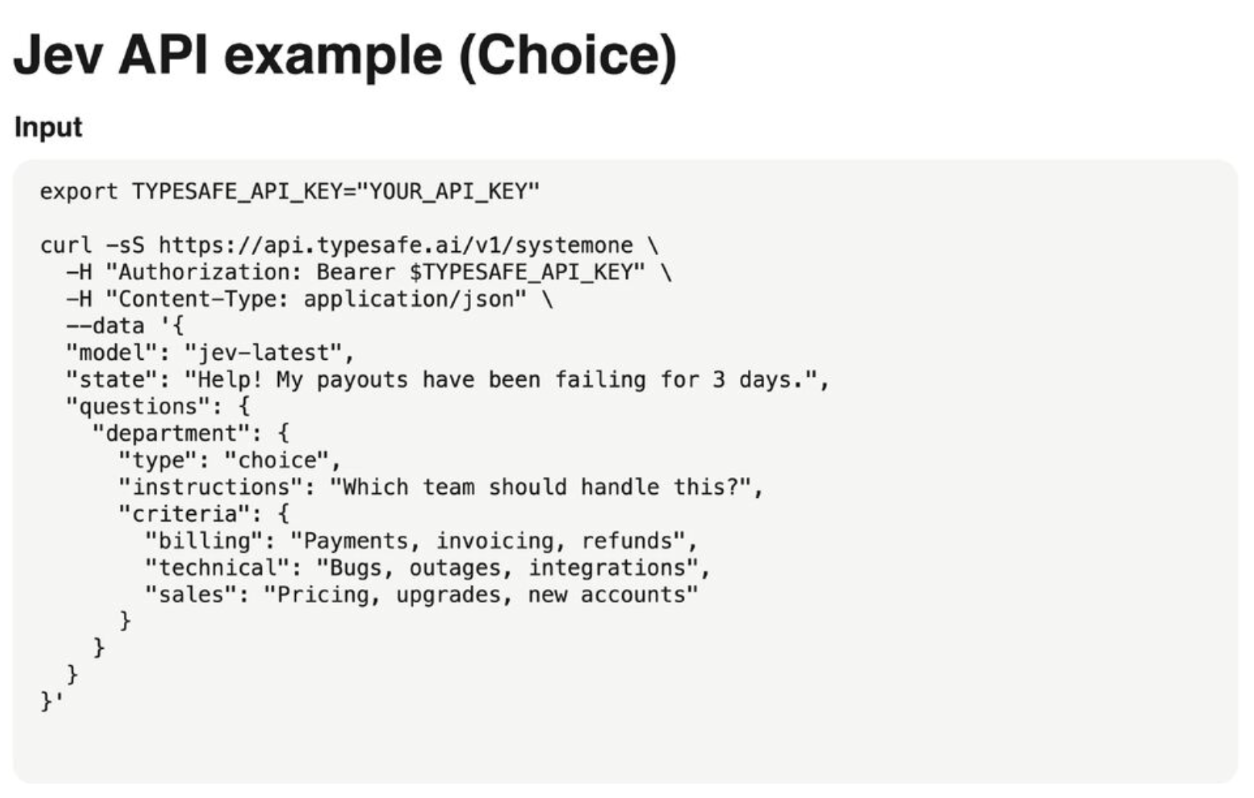
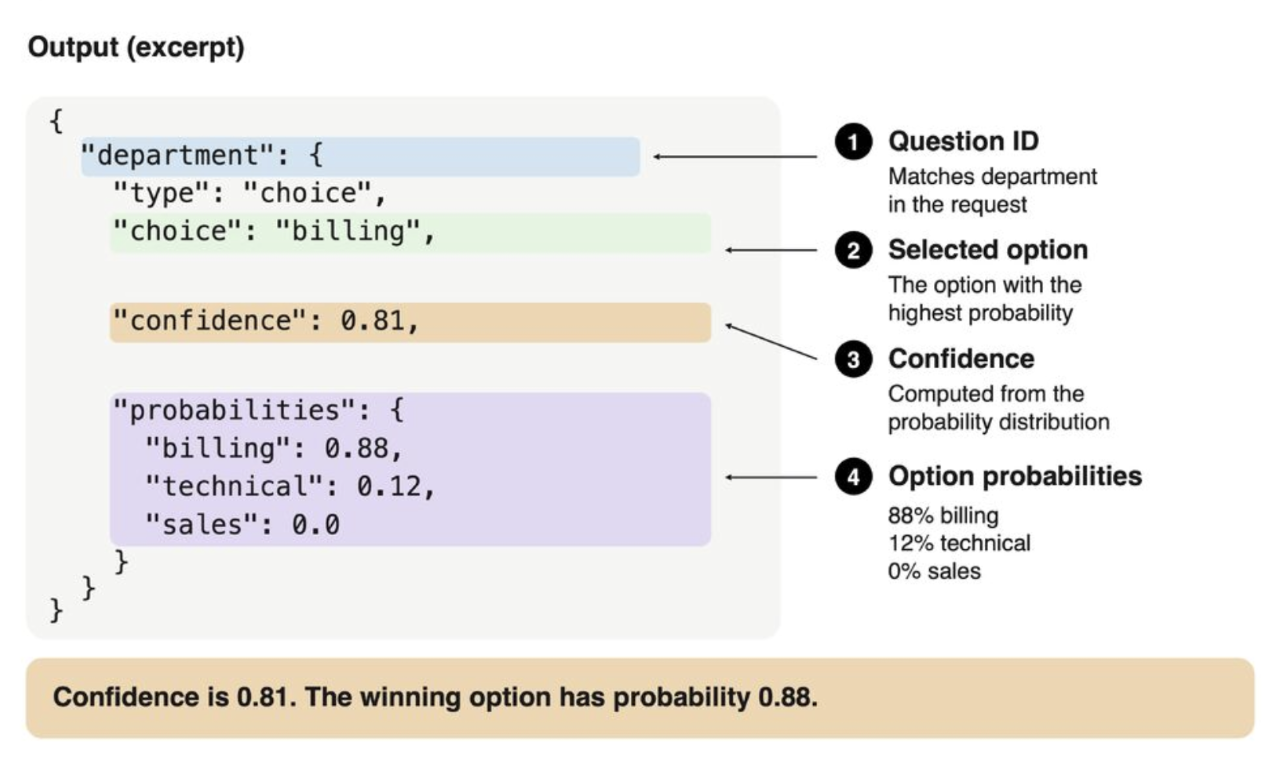
This “Choice” example illustrates a task of routing a customer complaint to the right department. The customer complaint is “My payouts have been failing for 3 days”, the question is “Which department should handle that?”
As you can see, the output of Jev states that with a 88% probability, the billing department should handle it. Jev gives this answer a confidence score of 0.81
Below is an example with “Noul”, which returns a “yes” or “no” answer.
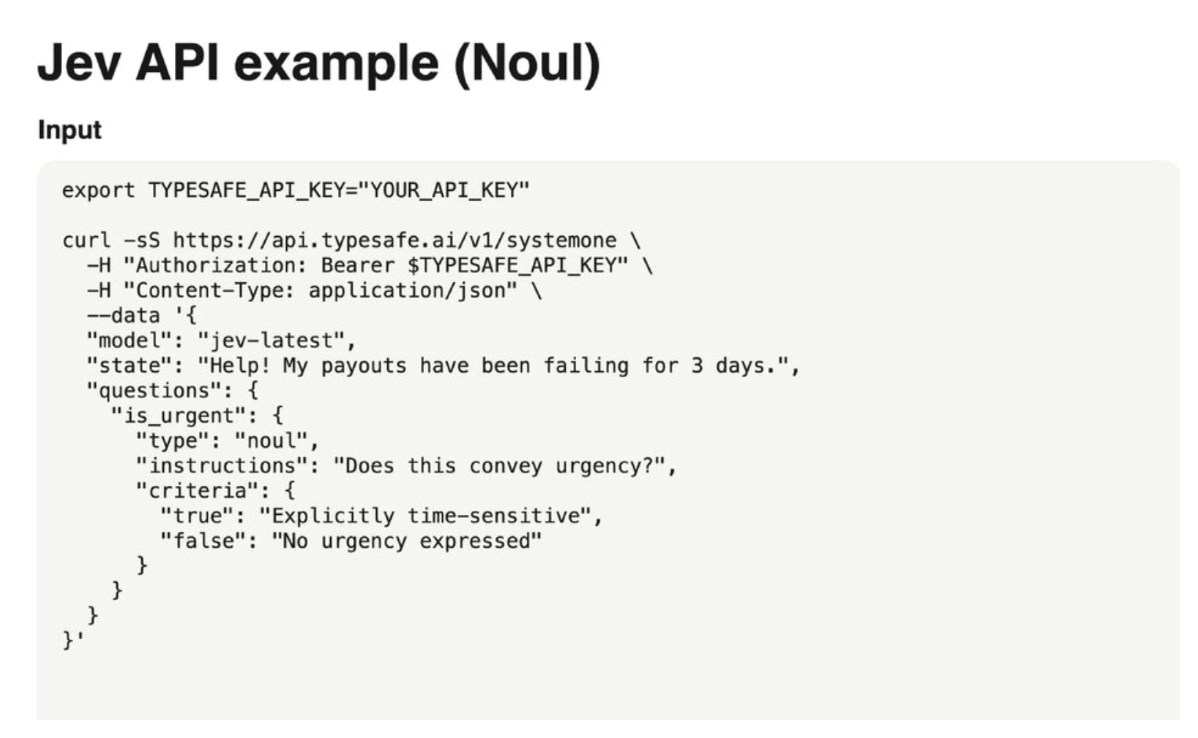
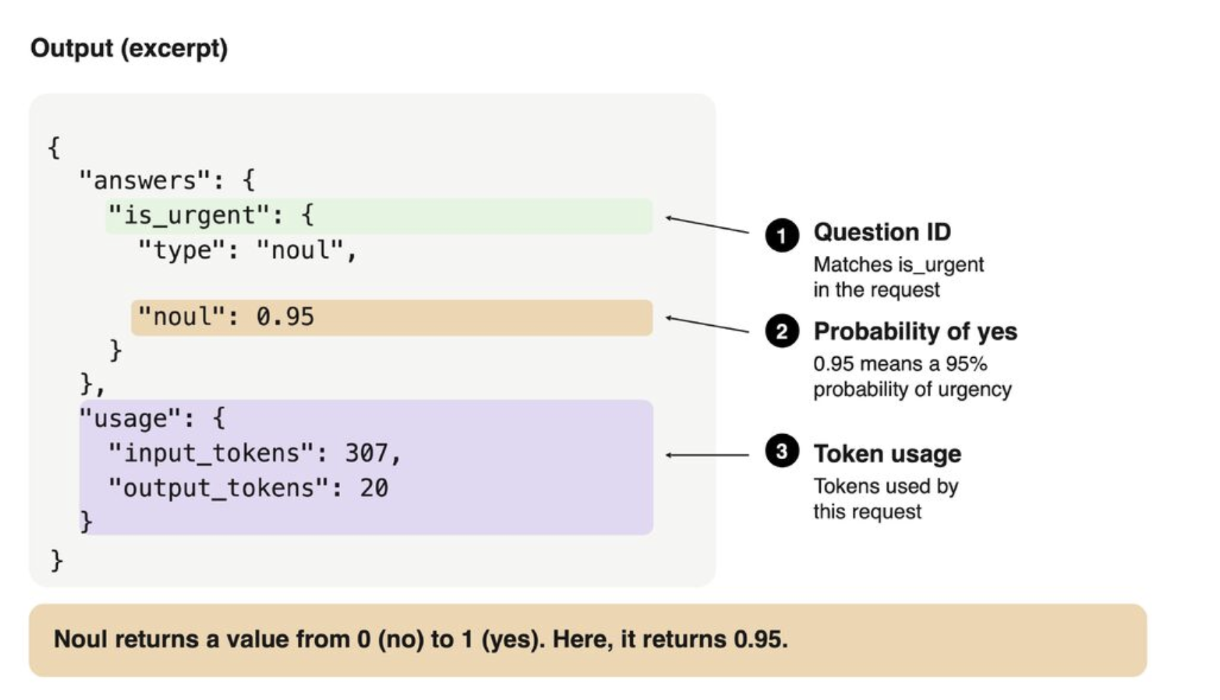
In this example, for the same customer complaint, the task is to determine how “urgent” this complaint is – “is this urgent?”
Jev returned the answer “yes” to the question with a confidence score of 0.95
Chenxi: So what is under the hood with these System One models? Is it simply a classifier?
Aaron: TypeSafe hasn't said what's under the hood. The best guess going around, and I share it, is what Sebastian Raschka wrote last week, a small encoder-style model, like ModernBERT, trained with a calibration-flavored RL objective, with the real edge in the training data. TypeSafe says Jev is "neither small nor an LLM," so hold that loosely.
It's easy to dismiss Jev as "just a classifier," and easy to overhype it. Classifying with an encoder isn't new. What's new is that one model generalizes across email triage, video games, and code without retraining.
Where System One Models Fall Short
Chenxi: You tested Jev, right? What did you find?
Aaron: We have a customer for whom we have been using Vecna agents to fix security vulnerabilities in codebases. Generating a plausible patch isn't the hard part; frontier and open models both do that. The hard part is knowing, cheaply, whether the patch is right.
So over the past month we have been testing whether any cheap scoring model could pick a correct fix without running the code. We tried majority voting, reward models, a frontier LLM as judge, and CLM-style contrastive heads used as verifiers, as well as one of the open Jev models, Laya. These are all measured against executed results on about 900 attempts. A fix only counted if the tests passed.
None of the scorers could tell a passing fix from a failing one on the same task. Head to head they were right 50 to 55 percent of the time, a coin flip. Picking the best of eight attempts with those scores did no better than random. Running the code did 13 to 17 points better.
The LLM judge had its own problem: it underrated fixes from open models by 10 to 20 points while grading its own family accurately, hence judge-based leaderboards overstate the gap between frontier and open models.
The result that stuck with me came from probing the frozen encoder directly. Its embeddings carried no pass/fail signal for same-task attempts at all. Attempt length predicted the score better than correctness did. That's the limit of a classifier. It can tell you which bucket something belongs in. It can't tell you whether the thing in the bucket is right.
And the real failure is structural. The agent fixes one vulnerable spot and misses a matching one in another file. No scorer can grade code the agent never looked at. In a coding agent the leverage is what you feed the model each turn, not the loop, and not the judge.
To summarize: A classifier can tell you which bucket something belongs in, but it cannot necessarily tell you whether the thing in that bucket is correct.
Chenxi: What, then, is the final takeaway?
Aaron: Putting execution inside the training loop. We sampled the model's own attempts, kept only the ones that passed in a real environment, and trained on those. That, plus environments calibrated so the reference fix passes and an empty patch fails, is where every point of improvement came from. Learned verifiers contributed nothing to the number we shipped.
We think the durable asset in this space is the library of executable environments and oracles, not a scoring model.
The Final Analysis:
We should use System One models for fast, high-volume decisions. Keep execution as the verifier for anything that ships. And treat any reranker result reported without an executed baseline as unproven.
“Scorers are cheap to build and cheap to copy. Environments that can prove a fix worked are neither.”
More from Vecna.ai on this in the future!